Tesla's Tailspin
Plus, China's zombie automakers flood the planet

Greetings from Motown!
You’ve got a lot to get done before you do the Cheshire Cat fade out for the holidays. And I have an @atthewheel podcast livestream today with Tu Le - join us at 1:30 ET!
So let’s jump right in to the news from World of Cars. We’ll get to fresh reporting about the surge of exports from left-behind Chinese auto factories, signs that U.S. car buyers may go on strike over high prices and doubts about the effectiveness of factory-floor AI.
But let’s start with Tesla - the only Western automaker that matters as far as the investor community is concerned.
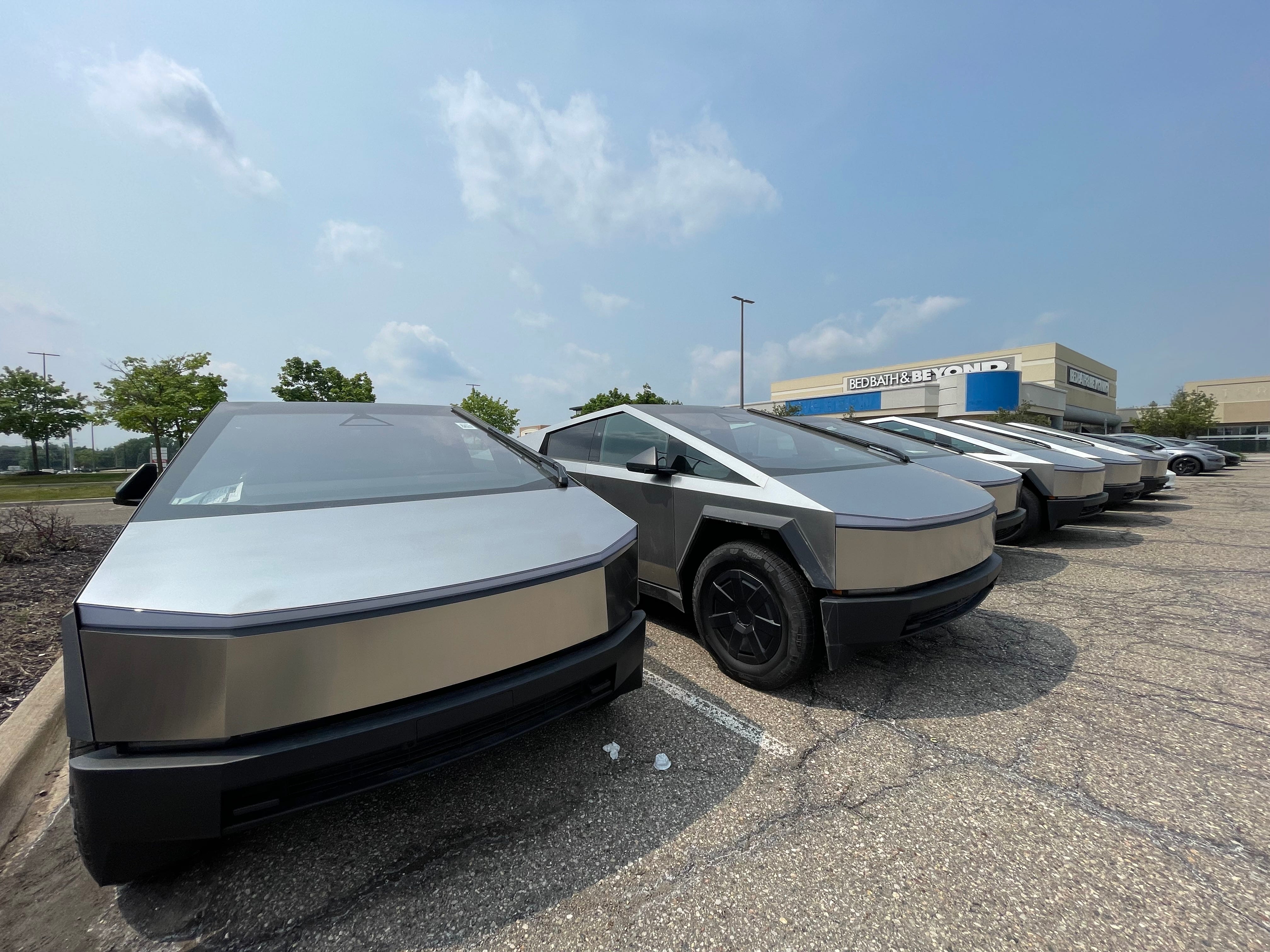
Tesla’s EV business is in a tailspin. The sales collapse has reached the point where excuses should be wearing thin - and would be at any other automaker.
Tesla was once the pioneering Model T-era Ford of electric vehicles. Suddenly it looks like the 1980s General Motors of EVs - dominant, but steadily losing market share as its products stagnate.
Tesla’s $1.35 trillion market cap and its 287 P/E ratio show investors don’t care about Tesla EV sales. But vehicle sales are still the core of the company pending commercialization of AI-adjacent products like the Optimus robot.
That core is in rough enough shape that this week investor Michael Burry - Mr. mortgage market Big Short turned AI Bubble Bear - called the company “ridiculously over-valued” in his Cassandra Unchained Substack letter.
In Europe, Tesla sales plunged 48.5% in October and are down nearly 30% for the year. See the ACEA data here.
Earlier this year, the excuse for Tesla’s slump in Europe was that lefty Continentals were unhappy with Elon Musk for his embrace of Donald Trump and his forays into European politics. That may be, but the sustained collapse in sales suggests there are bigger problems: Stale Tesla product and more capable competitors entering the EV market are two of them.
An important number that doesn’t get enough attention is the ratio of Tesla’s European sales to the capacity of its Berlin factory.
Tesla Berlin is capable of producing 375,000 vehicles a year, according to Tesla’s financials. As of Halloween, Tesla had sold just 180,688 vehicles in the European market. In October, Tesla sold just 6,964 vehicles in the world’s third-biggest market.
Preliminary figures for November published by Reuters suggest the rout is continuing.
Crude math suggests that at this rate, Tesla will be lucky to clear 200,000 vehicles sold in Europe this year - barely more than 50% of Berlin’s capacity.
Tesla told German workers and authorities earlier this year it did not expect to cut staff, because it was confident demand for Berlin’s Model Ys would increase with the launch of a refreshed model.
What has happened instead is that consumers are buying more EVs from Chinese brands and Volkswagen.
Chinese EV makers are launching an investment blitz in Europe that threatens Tesla’s efforts to regain lost ground - as well as legacy incumbents.
Great Wall Motors is the latest Chinese automaker to bust out an ambitious European strategy, including a plan to build a 300,000-vehicle per year assembly factory in Spain.
Tesla is also on the run in China, the world’s largest EV market. Sales fell in October to the lowest level in three years, down 36% from a year ago to just 26,000 vehicles. That equates to a 3.2% market share.
On the plus side, Tesla’s exports of Chinese-built EVs rose to 35,491 vehicles in October, a two-year high, according to China Passenger Car Association data cited by Reuters.
Like other automakers, Tesla is exporting vehicles from China to avoid tossing them into the price war that has enveloped the Chinese market. (More on that below.)
Let’s do more math: Tesla’s sales in China plus exports from its Shanghai factory added up to 62,000 vehicles in October. Tesla Shanghai has capacity to build 79,000 vehicles a month, based on Tesla’s disclosures.
That puts Tesla Shanghai’s capacity utilization at just under 80% - the industry benchmark for profitable operation. (Not every Tesla sold in China is built in Shanghai, but most are.)
Tesla does not report U.S. sales, but Cox Automotive estimates the brand’s sales dropped 35% in October.
Sales of EVs overall fell off a cliff in the United States following the termination of a $7,500 federal EV purchase subsidy. Cox sees the entire U.S. new vehicle market slowing down, not just EVs. More on that below.
In California, by far the largest EV market within the United States, Toyota is taking share away from Tesla, and Tesla registrations are down 15% for the first nine months of 2025, according to the latest data from the California New Car Dealers Association.
The Model Y is still the best-selling vehicle in California, but the hybridized Toyota Camry is now outselling the Model 3 in the sedan market. Toyota’s CFO said last month demand for its hybrids was so strong the company could barely keep up with demand.
With not one but two elephantine pay packages on the line, Elon Musk is working hard to persuade investors not to think of Tesla as a car company. He wants Tesla to be valued as a leader in defining the future of physical AI - artificial intelligence applied to robotaxis, factories and the machinery of economic life.
So far, Tesla is having trouble catching up with Waymo and Chinese rivals in deploying automated vehicles for hire. Tesla robotaxis still have human monitors in vehicles. Despite that the vehicles have been involved in as many as seven accidents since launching in June, according to government data reported by Electrek.
Federal safety regulators are also investigating Tesla’s “Full Self Driving” partial automation system following 14 crashes and 23 injuries.
As for Optimus, which Musk says is key to Tesla’s future growth, mark your calendars. Musk said during his Q3 results call the humanoid robots would go into production in 2026. Three years ago, he said robot production would begin in 2023.
China’s zombie automakers flood the world with ICE
The surge of vehicle exports from China in the past five years has been powered mainly by state-run automakers (and Western brands such as GM’s Chevrolet) putting petrol-burning models they cannot sell on ships for Eastern Europe, Latin America and Southeast Asia, Reuters auto reporter Nick Carey shows in a data-rich report.
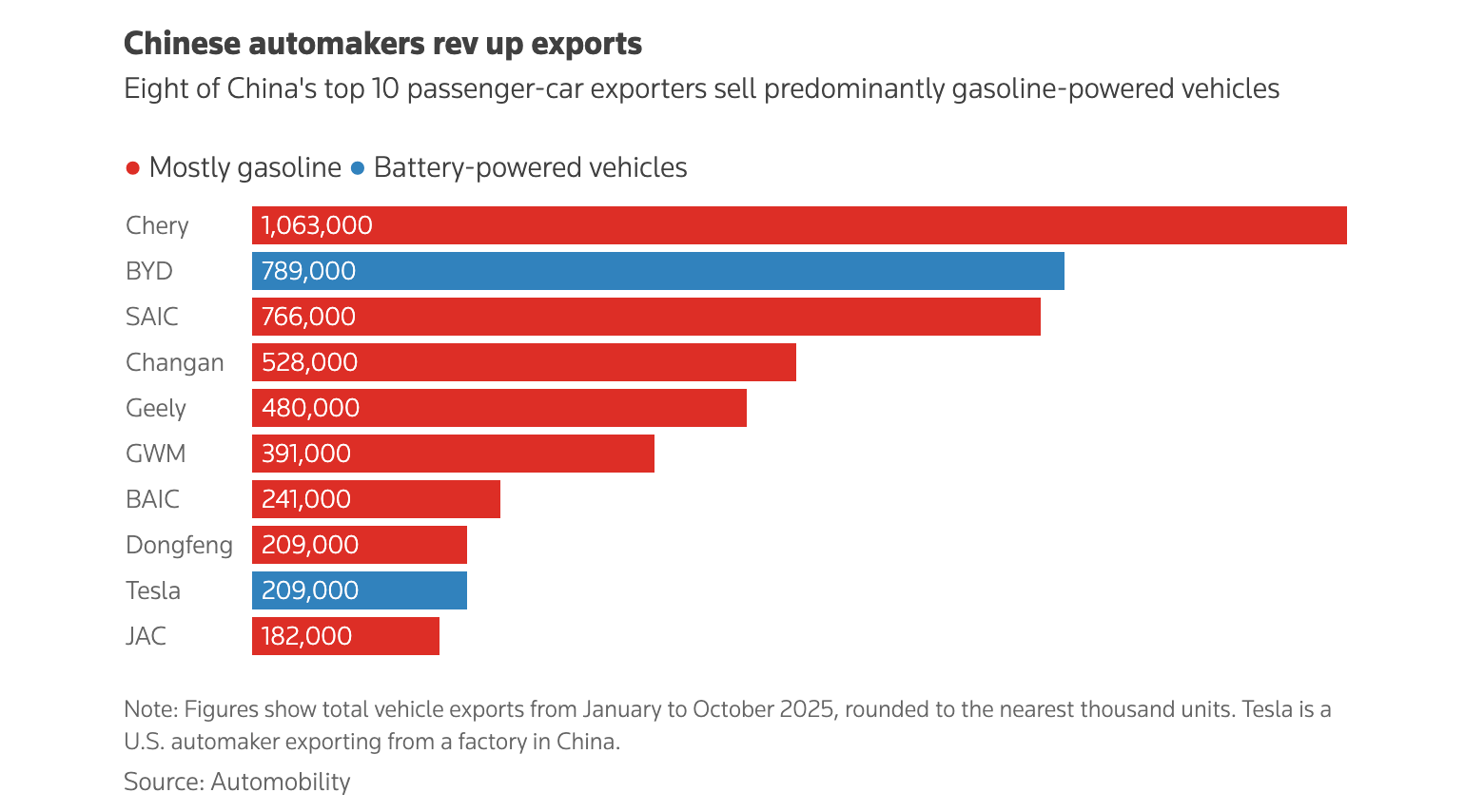
Demand for old-school petrol-fueled vehicles has plummeted in China as EVs and plug-in hybrids have captured more than half the market. But state-owned vehicle makers - and their joint ventures with Western automakers such as GM, Ford and Honda - have an imperative to keep assembly lines running to support tens of thousands of jobs.
What to do? Put cars on boats. GM has ramped up shipments of Chevy brand vehicles to Mexico from its Chinese factories. Chinese automakers Geely and Chery are making inroads in Eastern Europe and Southeast Asia. Russia was a big market for Chinese-made vehicles - until it wasn’t.
So what if Chinese gas guzzlers crowd streets in poor and middle-class markets? For global incumbents, those markets are critical now that the United States and Western Europe appear to have hit long-term plateaus.
Toyota once had a sales fortress in Southeast Asia. Chinese automakers are now jumping the moat. Stellantis and GM have invested heavily in Latin America and Mexico. Eastern European countries such as Poland are growth markets to Volkswagen, Renault, Toyota, Stellantis and Hyundai - or they were.
Up next: More calls from Western automakers for governments to act against dumping of Chinese vehicles.
Has America’s backlash against high vehicle prices really begun?
Are U.S. consumers finally going on strike against record high new vehicle prices?
Yes, the Wall Street Journal’s Sharon Terlep concluded based on data showing slowing sales and dealers who say shoppers are buying smaller, cheaper rides.
Cox Automotive forecasts that November U.S. new vehicle sales fell 8% from a year ago, sending the annualized sales pace down to 15.7 million vehicles from an average 16.2 million through the first 10 months of 2025.
It seems inevitable that automakers will come under pressure to cut prices with “affordability” the new magic word in American politics. But that is unlikely to happen soon, or to the degree that many would-be buyers would appreciate. Why not?
Automakers are shouldering billions in tariff costs - $10.6 billion for imports from Canada and Mexico, according to Anderson Economic Group data.
Cutting sticker prices could tank resale values, and put leases written three to four years ago in the red. That can create financial losses and customer ill-will. The fallout from Tesla’s price cuts in 2024 illustrates the problem.
Detroit’s automakers have painful memories of the cost of using big discounts to chase sales volume. GM, in particular, has vowed to maintain “discipline” in its pricing - code for sacrificing volume to defend prices for in-demand vehicles such as large pickups and SUVs.
Lightning laps
Automakers are still waiting for a game-changing payoff from billion-dollar investments in factory floor AI, Automotive News concluded after correlating AI investments at Ford and Hyundai to recall data and J.D. Power quality scores. The average number of Ford vehicles affected by component-related recalls fell sharply after the company began using an in-house industrial AI quality control system called AiTriz, AN found.
“However, Ford issued 22 recalls for manufacturing defects in vehicles built after December 2024, including issues like improperly torqued bolts and windshield installation problems — defect types that AI vision and torque monitoring systems are designed to catch.”
Rich folks really do like EVs. More than half of luxury car and luxury small SUV sales in California, and more than 40% of large luxury SUVs, were EVs through the first nine months of this year, according to new data from the California New Car Dealers Association. Combustion vehicles remain dominant in mainstream segments, with just 3.6% of “non-luxury cars” running on batteries. Data here.
European auto executives sounded the alarms as EU officials prepare later this month to rethink policies aimed at phasing out combustion vehicle sales by 2035. Stellantis Chair John Elkann warned of “irreversible decline.” Germany’s government weighed in on the industry’s side. Meanwhile, big European suppliers said Chinese rivals are flooding the market with cheap parts, creating a “Darwinian” struggle for survival.
European EV factories can build twice as many vehicles as the market currently demands, the FT reported.
One small step for China’s auto shakeout: Chinese automaker Changan took over an assembly plant formerly run by Hyundai.
Thanks for reading! More later…