The Gravity Defying Auto Industry
Plus, Stellantis Keeps on Trucking


Greetings from the journey to Mackinac Island!
Nevermind the Straits of Hormuz. Michigan has the Straits of Mackinac, featuring one of the world’s longest suspension bridges and a fort with cannons trained on the freighters and yachts headed for Detroit.
There are no cars on this lovely island. People get around on bikes or horse-drawn carriages. Apparently, that makes it a perfect place for a conference about economic and industrial policy for the birthplace of the U.S. auto industry. I’ll be here with my At The Wheel w/ Tu Le & Joe White partner Tu Le. New episode dropping soon.
Back on the mainland, the outlook for the Motor City Three and the rest of the U.S. auto sector is not so tranquil. Foggy and choppy are more like it.
Today’s High Speed Rodeo will take a look at Stellantis’ $70 billion bet on expanding revenue and profits in a stagnant market, the disconnect between consumer sentiment and car sales and Ferrari’s answer to the critics who say EVs are too expensive.
Let’s motor…
The U.S. auto sales miracle*
U.S. consumer confidence dropped last month to the lowest level ever recorded by the University of Michigan Survey of Consumers. Gasoline prices remain above $4 a gallon in much of the United States, with the exception of a few states where Republican governors have rolled back state fuel taxes.
Average transaction prices for new vehicles rose 1.8% in April vs. a year ago, according to new Cox Automotive data.
Good news: That rate of increase was half the long-term average. Bad news: New vehicle prices are still averaging close to $50,000, up 21% from pre-pandemic levels in 2020, according to Federal Reserve data.
(There are new vehicles available for under $35,000. But even those are out of reach for middle-income shoppers with stressed budgets and credit scores. )
Now, interest rates are rising amid a “global bond rout”.
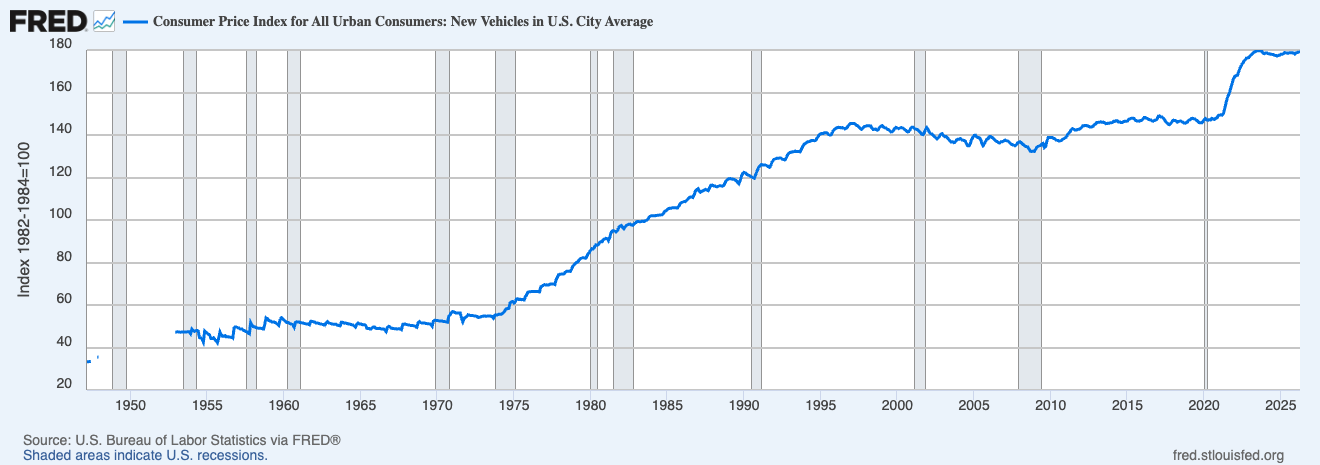
And yet: Forecasters at JD Power expect retail U.S. vehicle sales this month will rise by 6%. The annualized sales pace for the month will touch 16.3 million vehicles, Power forecasts. Once upon a time, the U.S. vehicle market tracked closer to 17 million cars and light trucks sold in a year. Those days are gone. Now, 16+ million is the new good.
The U.S. auto sector appears to be defying macroeconomic gravity. At least for now.
One reason could be that the new vehicle market largely reflects the outlook of affluent households, for whom $4 a gallon gas is an annoyance, but not a reason to radically change spending plans.
Transunion in a recent report said the share of U.S. consumers with “super prime” credit scores has increased since 2019.
High fuel prices have cost Americans nearly $45 billion since President Trump launched the war on Iran. But that works out to $190 on average per household since Trump started his Iran War. Wealthy families can handle that. (Giving up the daily Starbucks latte can save $1,500 a year.)
Another positive indicator for auto sales: The U.S. stock market is up for the year and touching new highs.
That said, automakers continue to pray for peace in the Middle East.
S&P Global cautioned in its latest global vehicle production outlook that the impact of the war and its economic toll could be delayed, hitting production and sales in 2027.
Plus, the industry has to figure out how to offset an estimated $30-40 billion in tariff costs. Stay tuned.
Stellantis hits the gas on trucks and SUVs
Stellantis CEO Antonio Filosa last week rolled out his 60 billion euro, five-year plan for restoring profitable growth at his sprawling, multi-brand automotive big box store.
The full presentation covers 168 PowerPoint slides. The key points:
North America will get 60% of the plan’s total investment, because North American truck and SUV segments are the deepest profit pools in the global auto industry.
Stellantis will drive to increase North American sales volume by 35% to 1.9 million vehicles while boosting pre-tax margins to 8-10% by 2030.
Double digit sales increases for Ram trucks and Jeep SUVs will be central to the strategy.
Stellantis will launch a new mid-size truck in North America to chase the Toyota Tacoma, Ford Ranger and Chevy Colorado. And the company plans a compact pickup truck to grab a slice of the market occupied by Ford’s Maverick and Hyundai’s Santa Cruz.
Thanks to the easing of U.S. fuel economy standards, Stellantis plans to launch an expanded lineup of SRT muscle cars and trucks that promise to generate 2-3X the margin of stock vehicles, North American brand chief Tim Kuniskis told investors.
Outside North America, Stellantis is counting on its Chinese partners Leapmotor and Dongfeng to boost capacity utilization in Europe to 80% from 60%, solving a significant cost problem.
There was some fun stuff. The Citroen brand plans to revive the legendary 2CV Deux Chevaux name for an electric European city car. North America will get a trio of hot-rodded Rumble Bee Ram trucks with 0-60 times under 6 seconds.

Investors were underwhelmed. Stellantis shares dropped sharply on 5/21 as the plan outline hit the web, but recovered Friday to just above par. For the year to date, Stellantis shares are down 33%.
Missing from the FastLane 2030 plan were commitments to phase out or sell underperforming or overlapping brands. Instead, Filosa outlined a plan to focus investment on four global brands, Jeep, Fiat, Ram and Peugeot, while maintaining the remaining brands as regional players. (Points if you can name them all.)1
No extra cash returns were promised to shareholders to offset the risks of a $70 billion capex plan. Remember that Stellantis earlier this year said it would write off 22 billion euros worth of investments in electric vehicles made under its previous five-year plan.
It will take until next year for Stellantis to generate positive free cash flow, if all goes well.
“If all goes well” carries a lot of freight. Stellantis forecast double-digit revenue gains in Europe and Latin America despite accelerating competition from Chinese brands.
The plan to boost Ram truck sales by 60% by 2030 in a flat overall North American market requires rivals such as Toyota, Ford and GM to cede ground without a margin-destroying fight. (See slide 24.)
Stellantis said it will launch the first vehicle powered by its Tesla-style STLA Brain computing architecture next year. It will take until 2035 for 70% of the company’s products to be equipped with advanced, software-defined computing architectures that Tesla, Rivian and major Chinese EV brands have today.
Stellantis originally announced plans for the STLA Brain in 2021 and targeted delivery starting in 2024.
Lightning laps
European EV sales are surging as consumers looked for relief from soaring petrol prices. Chinese brands are driving the shift, boosting combined European market share to a new high of 9.8%, according to data analyzed by Automotive News.
Ford said it will launch seven new models in Europe as part of plan to increase market share by 2029. Add all the market share predictions for Chinese and incumbent European automakers together and you get more than 100%.
Chinese automakers have a big incentive to invest in Mexico as a new 50% tariff takes hold, writes Friend of the Rodeo Warren Browne in IndustryWeek. New Chinese automaker factories in Mexico and Canada would add another twist to the upcoming renegotiation of the USMCA North American trade agreement.
Lawmakers in both parties of the U.S. Congress want to keep Chinese brands out of the U.S. market.
Trump’s trade war with Canada is shrinking the Motor City Three automakers presence in Canada.
A hybrid or an efficient gasoline car could be cheaper to rent for a day than an EV, despite high gas prices, the New York Times concluded. They did a lot of migraine-inducing math so you don’t have to.
Mercedes said it plans to launch a semi-automated driving system called MB. Drive Assist Pro, powered by NVIDIA chips, in Germany by the end of the year. Mercedes is racing Tesla, BMW and others to deploy hands-off driving systems.
Meanwhile in Berlin, proposals to charge congestion fees to attack the German capital’s traffic jams have sparked a culture war in Europe’s premium car nation.
Jaguar Land Rover will get a lifeline in the North American market from Stellantis. The two automakers said they will collaborate on vehicle development in the United States. JLR is fighting to recover from a calamitous year during which a cyber attack derailed production, and the company temporarily stopped shipping vehicles to the United States because of Trump’s threatened 25% tariffs. Collaborating with Stellantis could help boost the North American content of JLR vehicles, as well as reduce R&D costs.
One more thing…
Ferrari unveiled the Luce, the ultra-luxury brand’s long-awaited electric car, designed with help from former Apple design leader Jony Ive.
There she is.
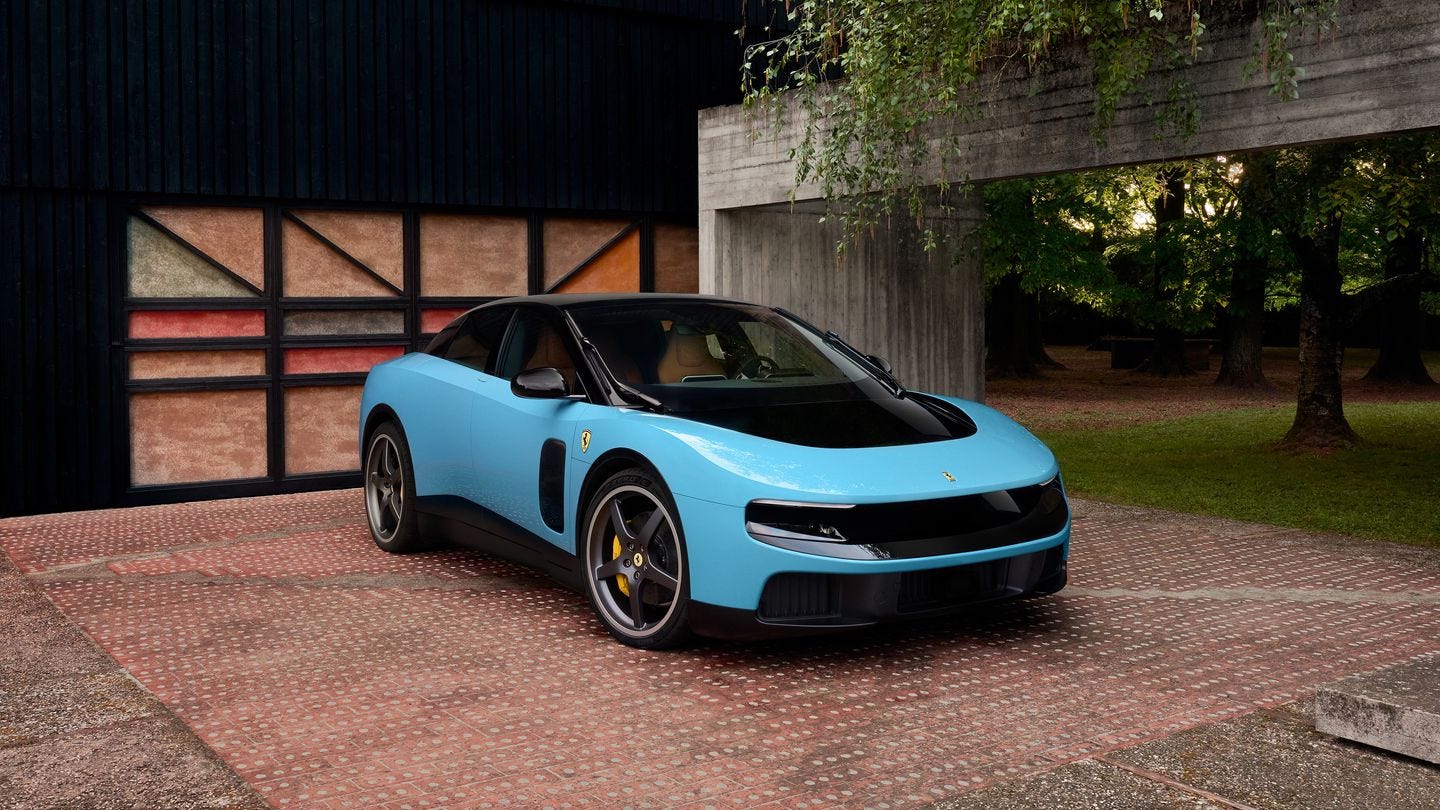
Guess how much. Too low. That’s a 550,000 euro/$640,000 vehicle you’re looking at.
The Luce has a long list of technology features. Here’s one I could relate to given my alter-ego as a guitar builder/cover band guitarist.
“A precision accelerometer at the centre of the axle captures the dynamic texture and vibration of the rotating components while the sound waves are moving. Developed in-house and patented, this system filters, equalises and amplifies the signal in a similar way to an electric guitar…”
I wonder if you could program this sound engine to play the opening riff to “Can’t You Hear Me Knocking” when you hit the accelerator? That might be worth $640,000.
Thanks for reading. More later…
Jeep. Ram. Fiat. Peugeot. Lancia. Citroen. DS. Chrysler. Dodge. Alfa Romeo. Opel. Vauxhall. Maserati. Ram Pro One. Leapmotor.