Uber's Robotaxi Blitz
Plus, About that U.S-Japan trade deal, and hybrids are back!

Greetings from Motown!
It has been a busy week in the World of Cars.
I spent the two days before Halloween at the Reuters Automotive USA conference in Detroit, where the mood among industry executives was...let’s call it wary optimism.
On the plus side, it President Trump is closing trade deals, notably with Japan, easing some import taxes on U.S. auto producers and ratcheting down tensions with China. More on that to follow.
Uncertainty over U.S. electric vehicle sales is giving way to conviction that for the time-being, combustion vehicles and hybrids will lead the way.
The billions burned on EV programs can’t be clawed back. But increased certainty is worth a lot.
“We thought we could leapfrog hybrids,” Volkswagen of America chief Kjell Gruner said at the Reuters conference. “We can’t.” VW is now working on hybrid versions of the Atlas and Tiguan SUVs for North America, he said.
The head of VW’s Scout brand told Bloomberg that over 80% of the customers making reservations for Scout SUVs want a gas-electric powertrain, not a pure EV.
Not so good is the state of the auto industry’s global supply chains.
The Nexperia chip crisis threatens to significantly disrupt vehicle auto production in Europe and North America - and as of Tuesday China and the Netherlands had not resolved the differences that led Beijing to slow supplies of semiconductors. Executives at the Reuters Automotive conference said more assembly lines could grind to a halt this month if Nexperia chips don’t start flowing.
Aluminum and steel tariffs are still causing pain for automakers in the United States. Now the Trump administration is threatening tariffs on imported machine tools and factory robots - not what automakers under pressure to expand production in U.S. factories want to hear.
The auto industry is the largest purchaser by far of machine tools and factory robots and most of that equipment is made outside America, albeit by allies such as Japan, South Korea and Germany. (Chinese factory equipment makers are installing most of their products at home, a cause for concern among people worried about U.S. competitiveness.)
Automakers aren’t alone in their anxiety. U.S. manufacturing overall has contracted for eight straight months as goods producers navigate tariff turbulence. Signs that U.S. consumers are stressed by rising food and health care costs don’t help.
Uber: King of the Robotaxi Universe?
EVs and tariffs are not new issues. For the sake of variety, let’s kick off with a look at Uber’s drive to scale up robotaxis across its global network - a strategy the Uber said last week it plans to accelerate via an alliance with NVIDIA, the $5 trillion AI super-chip and software power.
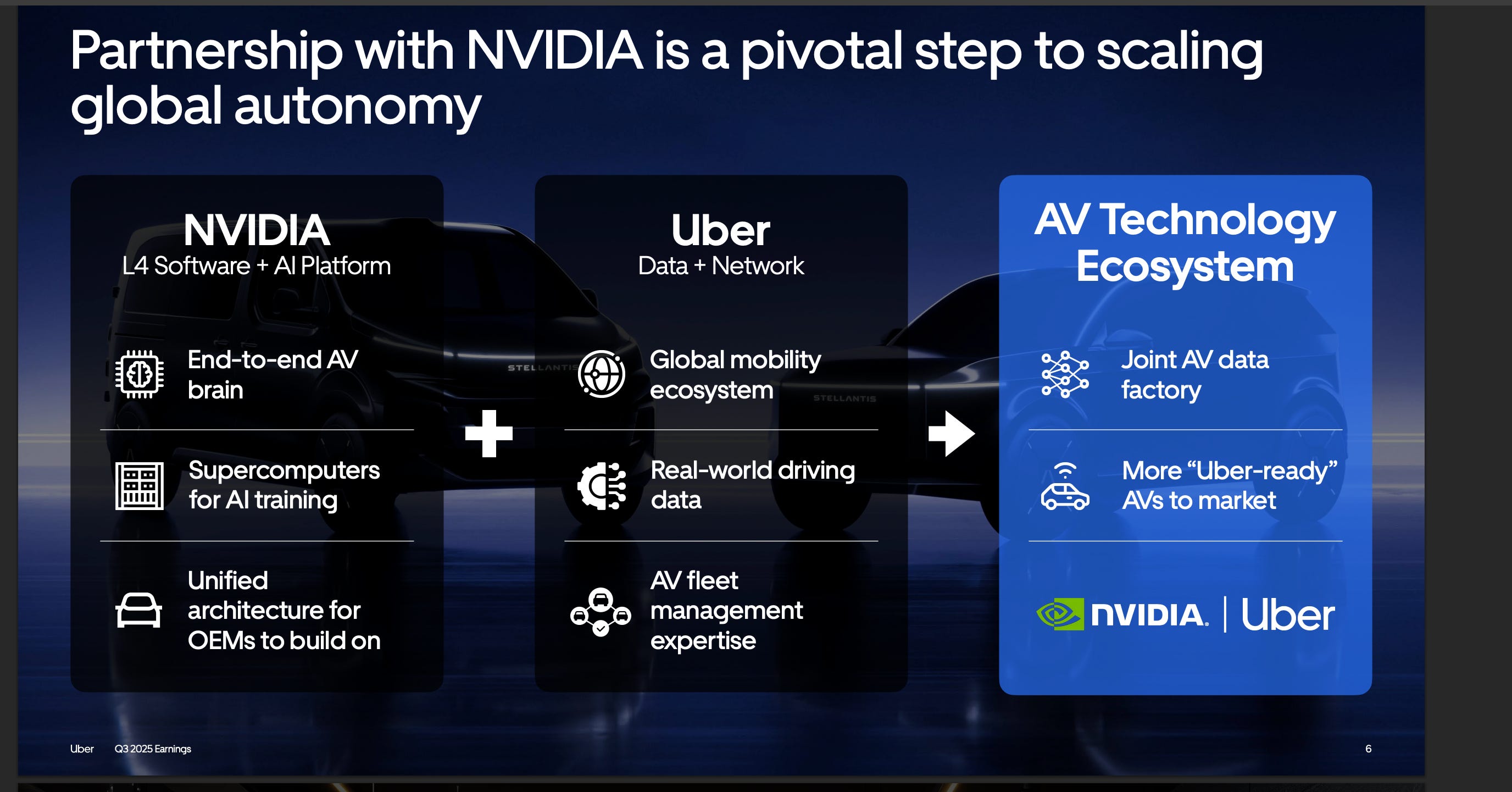
The NVIDIA-Uber deal is just one of a flock of alliances Uber has mustered to serve CEO Dara Khosrowshahi’s strategy of building the world’s largest automated vehicle deployment.
Uber has AV deals with:
Luxury EV maker Lucid to develop AVs with NVIDIA brains.
Chinese tech company Baidu, to deploy Baidu AVs on the Uber network.
Chinese startup WeRide to deploy robotaxis in the United Arab Emirates.
Chinese AV developer Pony.ai to deploy robotaxis in the Middle East.
Chinese startup Momenta to deploy AVs in Munich.
Volkswagen to deploy robo-vans in the United States.
Did I miss any? Probably. Uber is talking with Wall Street banks and private equity funds about raising capital to finance its robotaxi blitz.
Here’s what Khosrowshahi told investors on Tuesday (I highlighted the sentence about the deployment timeline.)
On AVs, our expanded partnership with NVIDIA is a pivotal step towards scaling the world’s largest L4 AV deployment, supported by NVIDIA building full-stack L4 software that can be integrated into multiple vehicle platforms.
This collaboration will accelerate deployment timelines, improve the unit economics of AV operations, and strengthen our ability to serve cities through a hybrid human-autonomous network. We’re also combining Uber’s global marketplace data with NVIDIA’s computing power to drive meaningful advances in high-quality training data, reliability, and long-term profitability for our AV partner ecosystem.
Looking ahead, we expect to be live with autonomous vehicle deployments on the Uber network in at least 10 cities by the end of 2026. We expect to build on our AV launches in Abu Dhabi, Atlanta, Austin, and Riyadh, bringing AVs to a multitude of markets in 2026-2027, including Arlington and Dallas, Texas; Dubai; London; Los Angeles; Munich; the San Francisco Bay Area; and many more to come.
The world of automated vehicles is the Westeros of mobility: It has long summers during which lots of capital flows into AV startups, followed by deadly winters that many inhabitants don’t survive- Uber’s own ill-fated effort to develop its own robotaxi technology included.
Now, Uber and NVIDIA are gearing up to bring on another AV summer. Uber’s push puts more pressure on Tesla CEO Elon Musk to demonstrate that he can make good on his ambitious robotaxi plans.
In the Robotaxi Race, the issue of what constitutes a moat will be getting a test. Is it the technology? Access to driving data? Or Uber’s brand recognition and its trove of knowledge about where people want to go and when harvested from its global network?
Whether all this good for the 9.4 million people who drive on Uber’s networks is another question. Khosrowshahi says Uber will have a “hybrid” network of human and robot drivers.
Uber’s motive for investing in robotaxis (and automated delivery) is easy enough to see on page 14 of the earnings deck. The company’s EBITDA margins in Q3 - a quarter of double-digit year over year growth - was just 4.5%.
Those are mediocre car company margins, not Magnificent Seven tech champion margins. Indeed, investors sold Uber shares on Tuesday over concerns about legal and regulatory costs that depressed the profit outlook.
Uber is not just working on AI-powered vehicles to improve that margin. It wants to deploy AI across its operations to cut costs. The company has launched a pilot program to pay drivers for “tasks like uploading or tagging photos to help train AI models.”
In other words, the drivers will be training their replacements. Very Rust Belt.
Japan, Trump and the F-150
OK, let’s get this straight. Ford is not going to exploit the newly-agreed trade deal with Japan to start exporting a substantial number of F-150 pickup trucks to Japan any time soon, no matter that Japanese Prime Minister Sanae Takaichi and her aides placed Ford trucks outside the venue for her talks with Trump.
If anything, the deal will help Toyota, Honda and other Japanese automakers with U.S. factories get some credits - financial and political - to offset taxes on their imported vehicles. Toyota said it will open its dealer network to U.S. brands.
(A Toyota executive said the automaker had not explicitly promised to invest another $10 billion in U.S. production - as Trump had suggested the company would.)
BMW, Mercedes and VW might get a break on SUVs or U.S.-made EVs they export to Japan.
It is meaningful that under the agreement, Japan will accept vehicles that meet U.S. safety standards. (The White House summary of the agreement is here.)
But it isn’t likely Detroit automakers are prepared to invest much to develop and export U.S.-made right-hand drive compact vehicles for a relatively small Japanese market - just over 4 million vehicles - that is dominated by very small kei cars like the diminutive Honda N Box.
Lightning laps
Carvana reported a surge in revenues and higher profits, with executives telling investors its online used-car sales business is benefiting from high new vehicle prices and consumer worries about tariffs.
Cox Automotive forecast U.S. vehicle sales will slow in October, in part because of an expected slump in EV demand. Still, Ford said its U.S. sales rose in October.
Volkswagen reported a quarterly loss, staggered by $5.8 billion in U.S. tariff costs and the troubles at Porsche. Separately, Hyundai said U.S. tariffs slashed more than $1.2 billion from Q3 profits.
Investors dumped Stellantis shares after the company warned it will take unspecified write-downs to recognize soured EV investments and warned that the Nexperia chip crunch could hit production.
Tesla sales plunged in Europe last month.
Canada will challenge Stellantis’ decision to shift production of Jeep models to a U.S. factory.
General Motors is furloughing more than 2,700 workers at U.S. assembly and battery factories in anticipation of slower EV sales.
From the Industry Consolidation Desk: Renault is talking with Chinese automaker Chery and other about sharing factories and technology, after agreeing to sell a stake in its Brazilian operations to Volvo Cars owner Geely.
Swedish EV startup Polestar was warned its U.S. shares could be delisted by NASDAQ unless they can regain a minimum $1 bid price. (Polestar was at 24 cents on Tuesday.)
Japanese automakers went back to the future for the Japan Mobility Show last week, displaying a whimsical collection of concept vehicles reminiscent of the Tokyo Motor Shows of the 1990s. AutoWeek focused on the trend to sleeker, sportier profiles among some of the concept cars.
And of course there was a flying car…
Thanks for reading. More later…